
Our SuiteCommerce Developer team ensures NetSuite website design is a delicate matter. The design of your website will very much influence the way your customers interact with your store, and therefore, your conversions: approximately 38% of website visitors will stop engaging with a website if the content or layout is unattractive.
If you read SuiteCommerce Advanced Theme — or any theme, for that matter — what is the first thing that comes to your mind? I can bet what your answer is: they are predefined layouts that can be modified design-wise in style, imagery, and colors to match a specific brand, its products, and its vertical.
And thus, typically, we see and think of theme selection as driven by aesthetics. However, they are so much more than that!
Themes and templates carry a shop flow, UX patterns, and even built-in features, which can be as important as how the theme looks. Have I piqued your interest? Read on!
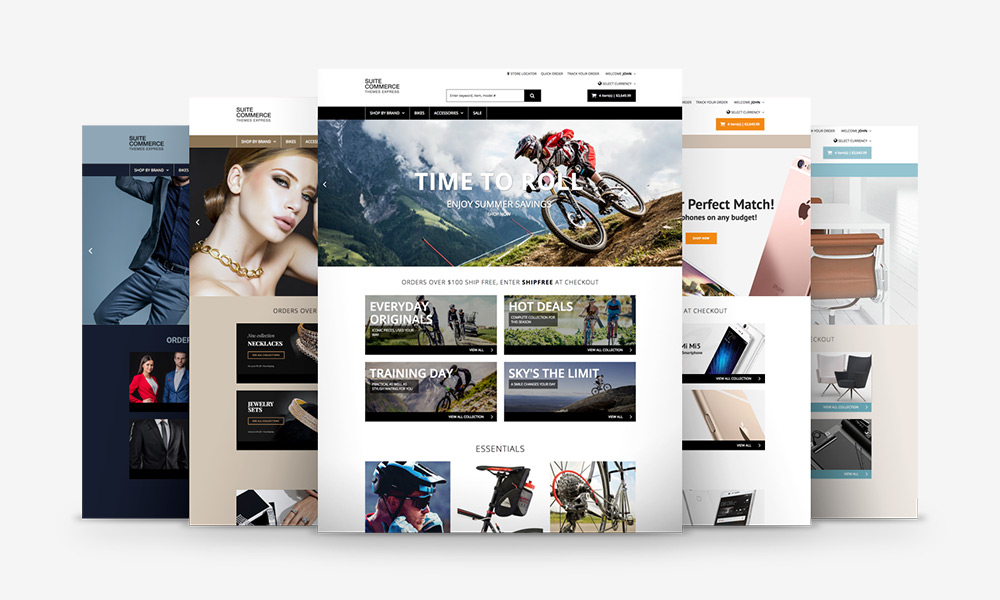
Theme design is great and all, and it’s right there in our faces for us to love or hate. But what about theme features? If I like the theme design, can I say that it will work for my audience?
You need to carefully review your theme options and ask yourself: which are the tasks I want my clients to perform and the ones I want to simplify for them? Or even better: what do I want for my users to achieve? What are my micro and macro conversion goals? What tools will my users need to accomplish these goals on my website?
The SuiteCommerce Advanced platform is investing in developing unique features. Some of these are industry standard e-Commerce features that work seamlessly on B2B or B2C experiences, such as:
Some other compelling features included on SCA are a much better fit for B2B eCommerce experiences, especially online retailers selling to wholesalers, distributors, and other retailers. In this case, shoppers may have different business goals and sometimes require additional tools or features.
Some of these features are:
More information on B2B features is included in the article What really makes a website suitable for B2B.
We explained what user experience stands for not so long ago and how it differentiates from simple user interface design. Este link no lleva a nada, no sé si modificar esta parte.
Even if all of the above-listed features come natively with SuiteCommerce Advanced, it’s essential to go through the exercise of analyzing which ones better fit your needs. At Tavano, when we designed our NetSuite Site Builder and SuiteCommerce Advanced Themes, we went through this exact process, leveraging what had worked and what hadn’t on hundreds of SuiteCommerce websites we’ve implemented through the years. We handpicked features that make sense to the needs of specific audiences: individual consumers, business consumers, wholesalers, distributors, and even verticals.
As a result, we designed themes targeted to specific audiences, including specialized features and shopper experiences aligned to the audience’s needs. Some examples of this are our SCA Landmark theme for online retailers selling B2B to wholesalers, distributors, and retailers, and our SCA Boutique theme designed for online merchants selling B2C to individual shoppers.
In conclusion, it’s not all about what you see. Of course, in a world where everything comes through the eyes, NetSuite website design is critical, but thinking about simplifying your users’ shopping experience will be like hitting the jackpot for your eCommerce business.
To implement a new SuiteCommerce Advanced theme or for help selecting a theme that’s right for your NetSuite website design, schedule a call with one of our SuiteCommerce developers!
Don’t forget to check out our NetSuite eCommerce services too:
For mid-market B2B brands running NetSuite, two platforms dominate the storefront decision: SuiteCommerce Advanced and… Read More
SuiteCommerce Advanced development is one of the more specialized skills in the eCommerce agency market.… Read More
One of the most consequential SEO decisions for eCommerce merchants is how to structure product… Read More
BigCommerce has become a leading choice for B2B brands building online storefronts. Its B2B Edition,… Read More
Based on an analysis of 7 million websites, SiteLock reported that websites experience an average… Read More
BigCommerce B2B Edition is BigCommerce's dedicated solution for wholesale and distribution businesses. It bundles a… Read More


